 Tours of Normandy from Paris
Best Time to Visit Normandy
The best time to visit Normandy on a trip from Paris is late spring or early autumn. Average highs in Caen reach 17.4 °C in May, 20.5 °C in June and 20.4 °C in September, and those months bring the fewest rainy days outside summer, 8 to 10 a month against 12 to 14 in winter. This guide works through the weather month by month, the 6 June anniversary week, seasonal opening hours, closed days and the dates when transport and tours run, so you can match the season to the trip you want. The tours themselves are compared on all Normandy tours from Paris.
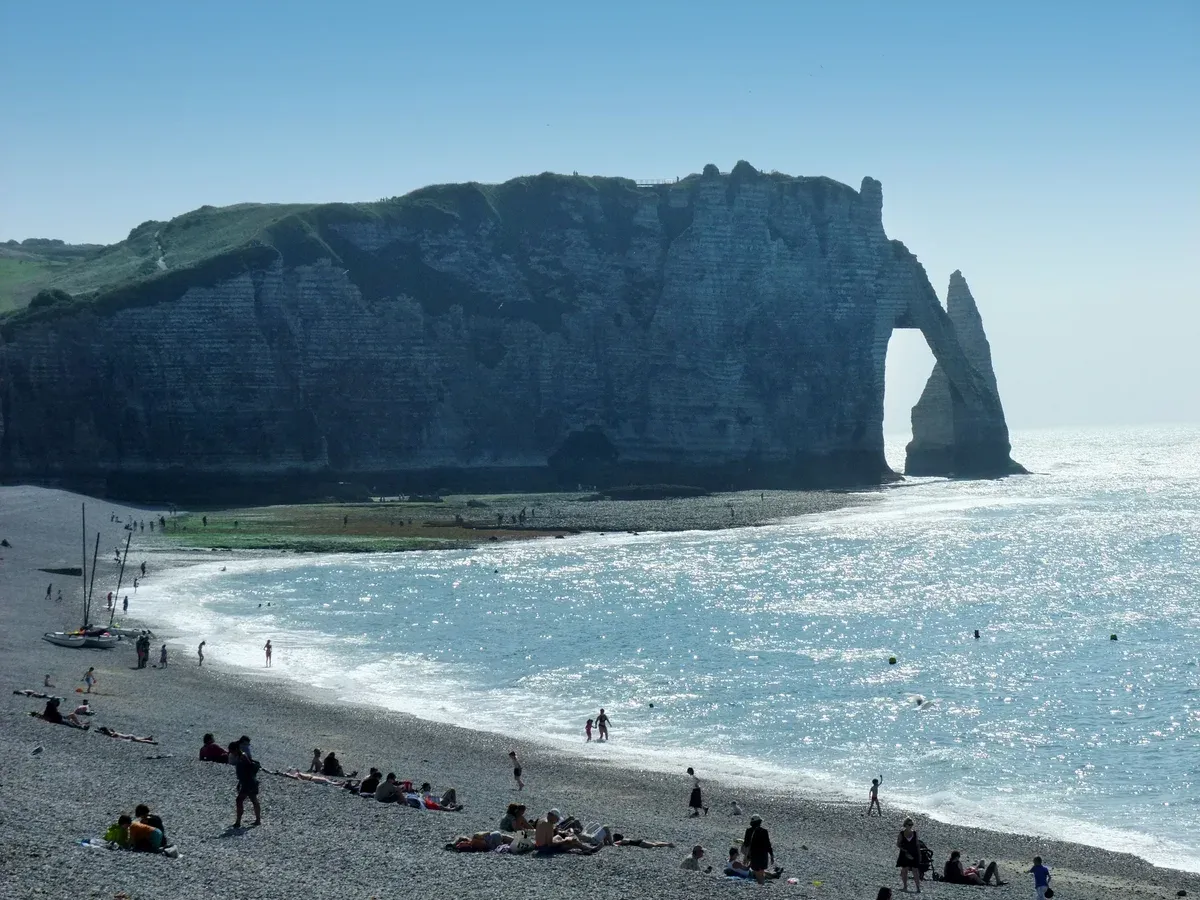
The Porte d'Aval and the Aiguille at Étretat. Photo: Nikater, Public domain, via Wikimedia Commons
Quick answer When to go
The best time to visit Normandy is May, June or September, when Caen averages 17.4 to 20.5 °C and 8 to 10 rainy days a month. Winter is mild, wet and quiet. Summer is warm but busiest. The first week of June brings anniversary road jams.
Key takeaways
- May and September give you mild weather and full opening hours at the D-Day beaches with thinner crowds.
- For a guided day, the D-Day beaches day trip with lunch runs from Paris and takes 14 hours.
- Abbey tickets cost €16 from 1 April to 30 September and €13 from 1 October to 31 March, so a Mont-Saint-Michel day trip is cheaper in the low season.
- Travelling without a car? The local bus to the beaches only runs from 20 April to 5 November, so read Paris to Normandy by train first.
Normandy Weather by Month
Caen sits in the middle of the region that most day trips from Paris cross, so its averages are a fair guide for the beaches and for the countryside on the way to Mont-Saint-Michel. The figures below come from published climate data for Caen.
Average Highs and Rainy Days
Normandy has an oceanic climate. Winters are cool rather than cold, summers are warm rather than hot, and rain can fall in any month. The pattern that matters for planning is the gap between the 8 rainy days a month from June to August and the 12 to 14 a month from October to January. Daylight also matters when your day trip starts at dawn and ends 14 hours later.
Read the table as averages, not promises. A 23.2 °C average high in August says nothing about a single wet Tuesday, and an 8.3 °C average in January often comes with bright, clear light on the coast. What the numbers do tell you is which months give you the best odds.
| Month | Average high in Caen | Rainy days | Planning note |
|---|---|---|---|
| January | 8.3 °C | 12 | Short days, quiet sites, closed days on 1 January |
| February | 9.1 °C | 11 | Low season abbey ticket, cold wind on the beaches |
| March | 11.7 °C | 11 | Spring starts, big tides near the equinox |
| April | 14.4 °C | 10 | Bus season starts 20 April, abbey summer ticket starts |
| May | 17.4 °C | 10 | Abbey closed 1 May, otherwise one of the best months |
| June | 20.5 °C | 8 | Warm and dry, but the 6 June week brings road jams |
| July | 22.9 °C | 8 | Peak crowds and peak car park prices at the Mount |
| August | 23.2 °C | 8 | Warmest month, busiest month, French school holidays |
| September | 20.4 °C | 10 | Warm sea air, summer hours, thinner crowds |
| October | 16.2 °C | 12 | Wet season begins, low season abbey ticket from 1 October |
| November | 11.8 °C | 13 | Bus to the beaches stops on 5 November |
| December | 8.8 °C | 14 | Wettest month, closed days on 25 December |
What the Weather Means for a Day Trip
A day trip from Paris to the D-Day beaches covers 286.2 km each way, about 3 h 21 min by car with no traffic, and tour operators budget 14 hours door to door for a coach day. You will spend a good part of that outdoors at Utah Beach, Pointe du Hoc and the American Cemetery at Colleville-sur-Mer. In June to August, 8 rainy days a month is a reasonable bet for dry ground at all three. In November to January, 12 to 14 rainy days a month means you should pack waterproofs whatever the forecast says.
Mont-Saint-Michel is 356.7 km from Paris, about 3 h 58 min by car with no traffic, and the visit is on foot, much of it exposed on the causeway and the ramparts. The free Le Passeur shuttle takes about 12 minutes from the car park and leaves you about 350 m from the ramparts. On a wet winter day that walk feels longer than it sounds.
Sources: ABMC, Normandy American Cemetery, ABMC, Pointe du Hoc
The Best Months, Ranked
Weather is only half the answer. Opening hours, ticket prices, bus season and crowd levels all move with the calendar.
May: The Best All-Round Month
May combines a 17.4 °C average high with 10 rainy days and long daylight. The abbey at Mont-Saint-Michel is on summer hours and the bus to the beaches has been running since 20 April. One date to avoid or plan around is 1 May, when the abbey is closed for the day.
Everything else on a typical itinerary is open, and the summer holiday crowds have not arrived.
June: Warm and Dry, With One Difficult Week
June has the joint-lowest rainfall in the year at 8 rainy days and a 20.5 °C average high. Outside the first week, it is close to perfect for the beaches and the Mount. The first week is different, and it gets its own section below because the 6 June anniversary changes the roads around Caen, Bayeux and Arromanches.
If your dates are flexible, aim for the second half of the month.
September: The Local Favourite
September keeps summer hours and a 20.4 °C average high, and rain is still at 10 days. The school holidays are over in France, so the Mount's car parks and the beach villages calm down while everything stays open. The big tides fall near the equinox, and when the tidal coefficient passes 110 the causeway is covered and the Mont becomes an island again for a few hours.
Check tide dates before you go, and never cross the bay on foot without a guide.
July and August: Warmest and Busiest
August is the warmest month at 23.2 °C and July is close behind at 22.9 °C, both with only 8 rainy days. The cost is crowds. The Mount's car park rises to about €20-28 for up to 3 hours in July and August, against about €16-22 in mid season, and the abbey runs its longest hours, 9:00-19:00 from May to August, partly to spread visitors out.
If you drive yourself, arrive early. If you take a coach tour, the schedule is fixed for you and a Mont-Saint-Michel day trip with a guide puts the abbey ticket and the timing in someone else's hands.
October to March: Quiet, Cheaper, Wetter
From October the rain doubles, 12 to 14 rainy days a month through to January, and the average high falls from 16.2 °C in October to 8.3 °C in January. What you gain is space and lower prices. The abbey ticket drops from €16 to €13 from 1 October to 31 March, and the Mont-Saint-Michel coach day trip is the cheapest way onto the rock all year.
Note the winter closing days before you fix a date: the abbey shuts on 1 January and 25 December, the American Cemetery closes on 25 December and 1 January, and the Juno Beach Centre closes on the same two days. The local bus to the beaches stops running on 5 November and does not resume until 20 April.
The 6 June Anniversary Week
The D-Day commemorations run around 4-7 June each year. It is the most moving week to be in Normandy and, for a day tripper from Paris, the most difficult.
What Actually Happens on the Ground
Roads between Caen, Bayeux, Arromanches and the beaches jam, and some communes close to traffic entirely. The official ceremony at the Normandy American Cemetery is by invitation only, so turning up hoping to watch it is not a plan. Coach tours that normally stop at Pointe du Hoc or the cemetery can lose an hour or more to diversions in that window.
If the anniversary matters to you, go anyway, but go early in the day and expect to walk further than usual. If your interest is the sites themselves, pick any other week in June. The weather is identical and the roads are open. A 14-hour day such as the Normandy D-Day beaches day trip with lunch, which visits Utah Beach, Pointe du Hoc, Omaha Beach and the cemetery, is much easier in the second half of the month than in the first.
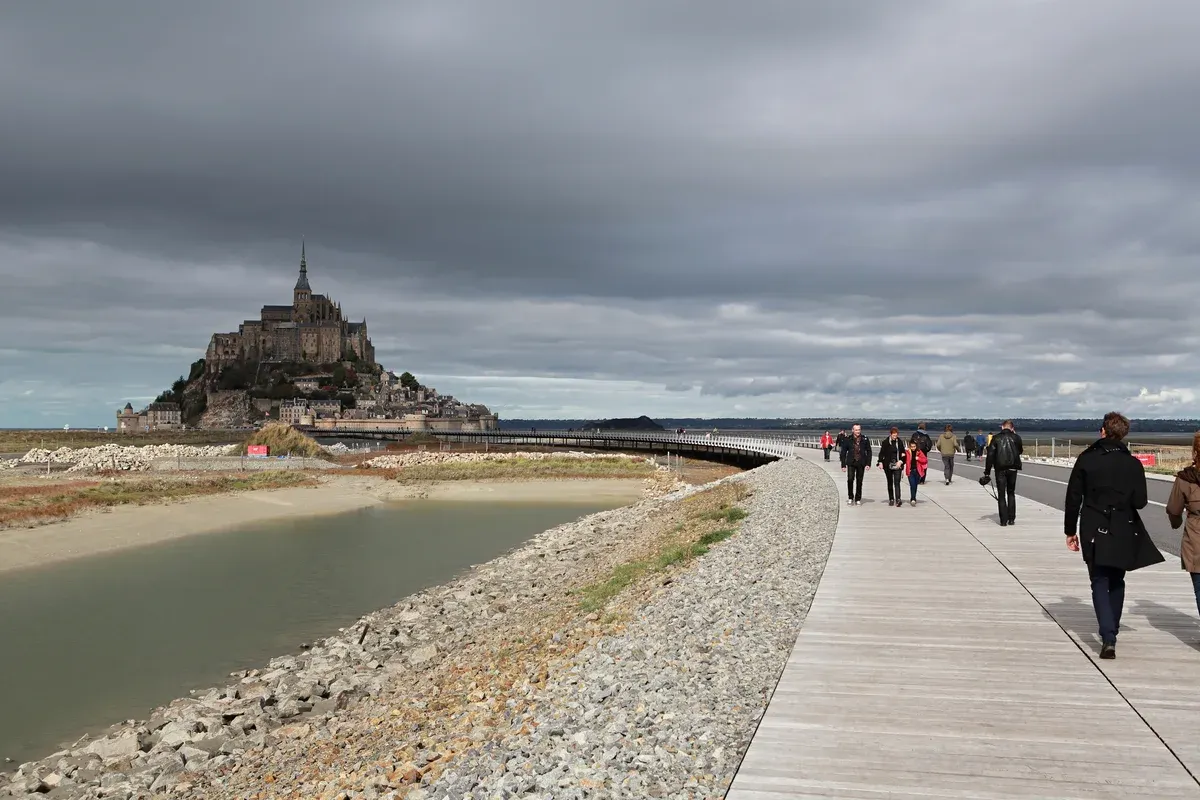
The access bridge to Mont-Saint-Michel. Photo: Martin Cígler, CC BY-SA 3.0, via Wikimedia Commons
Seasonal Hours, Tickets and Closed Days
The month you pick decides what is open, what it costs and how you get there. These are the dates that change.
Mont-Saint-Michel Abbey
The abbey opens 9:00-19:00 from May to August and 9:30-18:00 from September to April, with last entry 1 hour before closing. The adult ticket is €16 from 1 April to 30 September and €13 from 1 October to 31 March. That is $18.24 against $14.82 at the reference rate, so a low-season visit saves €3 a head.
Free entry applies to under-18s and EU residents aged 18-25. The abbey closes on 1 January, 1 May and 25 December, and no suitcases are allowed inside.
Pointe Du Hoc and the American Cemetery
Pointe du Hoc is free to enter, with free parking, and the visitor centre opens 9:00-17:00 from 1 April to 30 September. A restoration project runs through mid-2027, so parts of the site may be closed at any time, though public access to the site itself is kept open. The Normandy American Cemetery holds 9,389 American war dead with 1,557 names on the Walls of the Missing.
It is free, open daily 9:00-17:00, and closed on 25 December and 1 January. The flag-lowering ceremony takes place one hour before closing. Note that the path from the cemetery down to Omaha Beach has been closed since 2016, so reach the beach from the separate public access nearby.
Getting There Without a Car
There is no train station at the beaches or at the cemetery. From Bayeux, the Nomad bus line 120 runs to Colleville-sur-Mer and Grandcamp-Maisy, but only one round trip a day, Monday to Saturday, and only from 20 April to 5 November. No public transport reaches Pointe du Hoc at all.
Trains to Bayeux run about 14 times a day from Paris Saint-Lazare, averaging 2 h 58 with a fastest time of 2 h 12, so in the low season a car, or a coach day trip, is the only practical way to the American sector. Mont-Saint-Michel is easier year round, though the train and bus combination from Paris-Montparnasse still takes about 4 h to 4 h 30 each way. Our Paris to Mont-Saint-Michel guide sets out the options.
What a Visit Costs by Season
Most entry fees in Normandy do not change with the season, but the abbey ticket, the Mount's car park and the practical cost of reaching the beaches all do. The table compares the published prices and the tour prices for a day from Paris.
Entry Fees and Tour Prices Compared
The figures below come from the official sites for the abbey, the Utah Beach Landing Museum and the Juno Beach Centre, and from the tour listings on this site. Euro fees carry a dollar conversion where the published reference rate allows one. Tour prices are the operators' listed prices.
The pattern is simple. Almost nothing is cheaper in winter except the abbey ticket, €13 against €16, and the low-season advantage is mostly about space, not money. Guided day trips from Paris are priced the same all year, from $101 for the basic Mont-Saint-Michel coach to $952 for a three-day tour that adds the Loire châteaux.
| Item | High season | Low season | Season dates |
|---|---|---|---|
| Mont-Saint-Michel abbey ticket | €16 ($18.24) | €13 ($14.82) | High 1 Apr-30 Sep, low 1 Oct-31 Mar |
| Mount car park, up to 3 hours | €20-28 in Jul-Aug | €16-22 mid season | First 30 min free |
| Utah Beach Landing Museum | €10 ($11.40) | €10 ($11.40) | Hours change, 9:30-19:00 May-Sep |
| Juno Beach Centre, museum | €9 ($10.26) | €9 ($10.26) | With bunker tour €13.50 ($15.39) |
| Cheapest Mount day trip from Paris | $101 | $101 | Abbey ticket included |
| Cheapest D-Day day with lunch from Paris | $129 | $129 | Utah Beach Museum entry included |
Reading the Prices Honestly
Check what a tour price leaves out. Lunch is included on some days and not others, and the abbey ticket is only included where the listing says so. On the combined Omaha and Mont-Saint-Michel day, $231 for 15 hours, the abbey ticket comes only with the option that adds it.
On the private combined day, $518, all site fees and the abbey ticket are in the price, and hotel pickup at 7:30 is part of the deal. The 3-day Normandy, Mont-Saint-Michel and Loire tour at $952 includes breakfasts and a 3-course dinner in Caen but not lunches. Winter travel saves you nothing on any of these, so if price drives your choice, choose the format, not the month.
Which Season Fits You
There is no single best time to visit Normandy. Match the month to the trip you want to make.
If You want the beaches in the best weather with the fewest people
Come in May or the second half of June, or in September. A small-group day such as the D-Day beaches minivan tour, up to 8 people for $302, is at its calmest outside the anniversary week.
If You want to be there for the commemorations
Plan for the 4-7 June window, arrive early, expect road closures and know the cemetery ceremony is invitation only.
If You are travelling without a car
Travel between 20 April and 5 November so the Nomad bus to the beaches is running, or book a coach day. See Paris to Normandy by train.
If You are on a budget and flexible
Go between 1 October and 31 March. The abbey ticket falls to €13 ($14.82) and crowds thin out, but pack for 12-14 rainy days a month.
If You want the cliff towns as well as the war sites
Any month works for the private Étretat, Honfleur and Rouen day, since it runs from your hotel door, though the Étretat gardens tickets are not included.
If You have young children and want the shortest possible exposure to bad weather
Choose July or August, when only 8 days a month bring rain, and expect company. The coach day to Mont-Saint-Michel with a guide handles the logistics for you.
Best Time to Visit Normandy: Questions
What is the best time to go to Normandy?
May, June and September are the best months, with Caen averaging 17.4 to 20.5 °C and 8 to 10 rainy days. Avoid the first week of June for the roads, as the anniversary commemorations jam the routes between Caen, Bayeux and the beaches. For a guided option in those months, see the D-Day beaches day trip with lunch.
Is April a good time to visit Normandy?
Yes, with one caveat. Caen averages 14.4 °C with 10 rainy days in April, and the season turns on 20 April, when the Nomad bus to the beaches starts and the abbey moves to its higher summer ticket of €16 ($18.24). If you need public transport to the sites, come after 20 April or book a coach day such as the D-Day beaches and Arromanches day trip.
What is Normandy like in winter?
Mild but wet and quiet. Average highs in Caen run from 8.3 °C in January to 11.7 °C in March, with 11 to 14 rainy days a month. The abbey ticket drops to €13 ($14.82), the cemetery stays open 9:00-17:00, but the beaches bus stops on 5 November and the abbey closes on 1 January and 25 December. The Normandy American Cemetery guide covers the winter practicalities.
How many days do you need in Normandy?
One long day covers either the American sector or Mont-Saint-Michel, since each is a 12 to 15 hour round trip from Paris. Two days let you do both, and a season with long daylight such as May or September makes the 14-hour days easier. The 2-day Normandy trip from Paris guide sets out a two-day plan.
How long is the train ride from Paris to Normandy?
About 2 h 58 on average from Paris Saint-Lazare to Bayeux, with a fastest train of 2 h 12, and about 1 h 30 to Rouen. The beaches themselves have no station, so from Bayeux you need the Nomad bus, which only runs one round trip a day and only from 20 April to 5 November. Details are in Paris to Normandy by train.
Does the season change the Mont-Saint-Michel tides?
The biggest tides fall around the equinoxes, in spring and autumn. When the tidal coefficient passes 110, the causeway is covered and the Mont becomes an island for a few hours. Spring and September visits give you the best chance of seeing it, and you should never cross the bay on foot without a guide. Timing tips are in the Paris to Mont-Saint-Michel guide.
Is the weather better in Normandy or Paris?
They are close, but Normandy is the oceanic coast, so it is a little windier and the rain is spread across the year. Caen averages 8 rainy days in summer against 12 to 14 from October to January, and the warmest month is August at 23.2 °C. If your Paris days look settled, spend one of them in Normandy on a Normandy day trip from Paris.